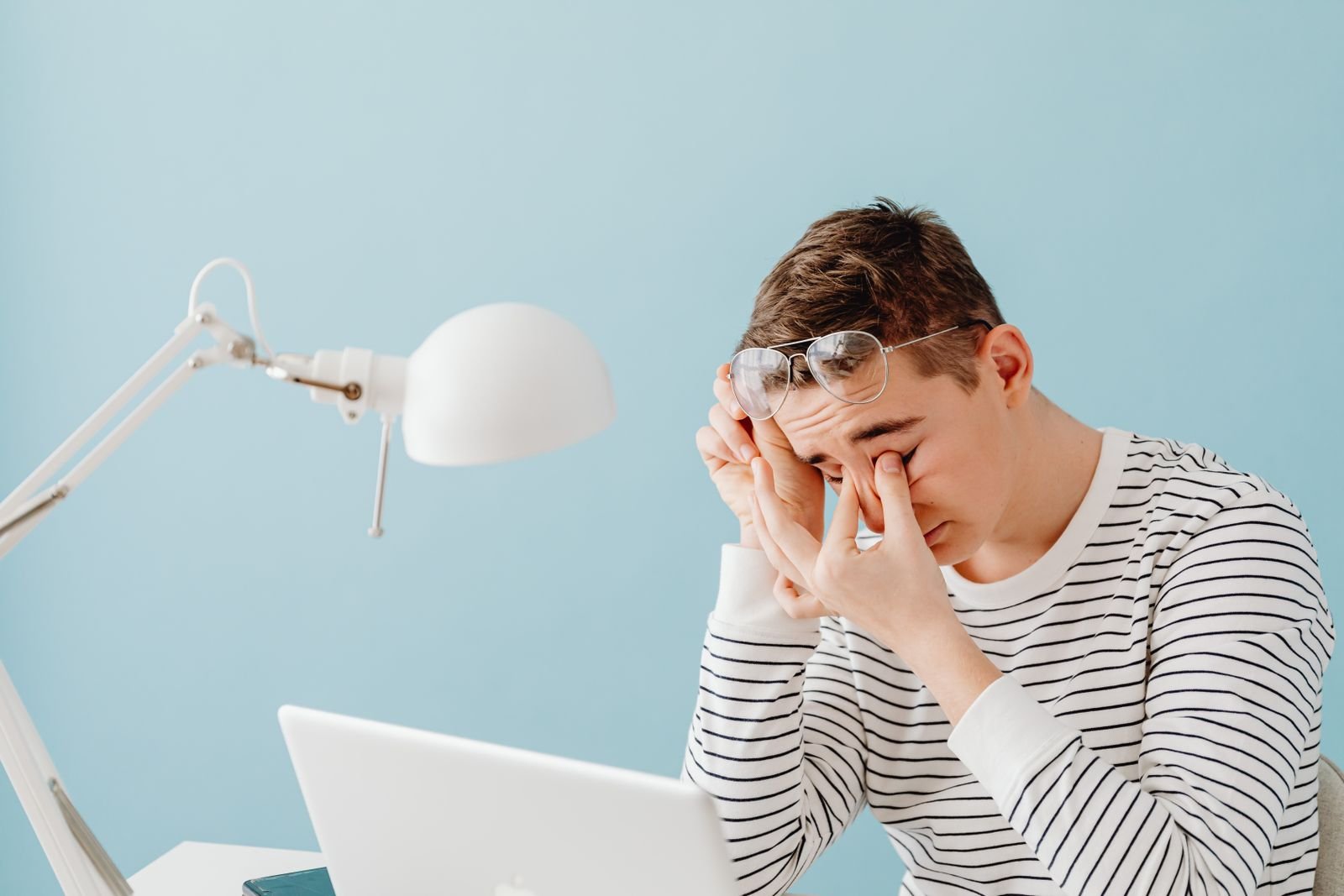
Eye strain is tired, uncomfortable eyes after long close work, most often screens, reading or driving. The main symptoms are aching or heavy eyes, headaches, blurred vision, dry or watery eyes, burning or stinging, and sensitivity to light. Rest your eyes, follow the 20-20-20 rule, check your screen setup, and book an eye test if symptoms keep coming back.
What eye strain is, and what it is not
Eye strain, also called asthenopia, is not one disease. It is a set of symptoms that appear when your eyes work harder than usual for a long time. Close focusing uses the small muscles inside the eye, and holding that focus for hours tires them. You also blink less often when you concentrate, so the front of the eye dries. Dryness then adds burning, grittiness and blurred vision.
Eye strain is common and it usually settles with rest. It does not mean your eyes are damaged. The Health and Safety Executive says display screen equipment work does not cause permanent damage to eyes, but it can make you aware of an eyesight problem you had not noticed.
Eye strain is not an eye infection, an allergy, or a sudden eye problem. Infection usually brings redness, discharge, pain or a swollen eyelid. Allergy usually brings itching, watering and redness in both eyes. A sudden change in vision, severe eye pain, flashing lights or loss of vision is not ordinary eye strain. The red flags at the end of this article say when to call 999 or go to A and E.
Most eye strain has one of four causes, or a mix of them: screen strain, dry eye, an out-of-date prescription, or eyes that struggle to work together at close range. Treatment differs by cause. Drops help dry eye, but they do not fix an out-of-date prescription.
Symptom checklist by cause
Use this table as a starting point, not as a diagnosis. Find the row that sounds most like you, then test it with the self-check in the next section.
Table 1: Eye strain symptoms by likely cause
| Cause | Main symptoms | When it is worst | What often helps first |
|---|---|---|---|
| Screen strain | Aching or heavy eyes, headaches, blurred vision that clears when you blink | After long screen sessions, late in the day | Regular breaks, 20-20-20 rule, good lighting |
| Dry eye | Burning or gritty feeling, blurred vision that comes and goes, watery eyes | In dry or heated rooms, after long screen use | Blinking often, lubricating drops, warm compress |
| Out-of-date prescription | Headaches after reading or screen work, difficulty focusing, blurred vision at one distance | After reading, screen work or driving at night | An eye test and the right glasses |
| Convergence problem | Words move or double when reading, losing your place, headaches | Close work for more than a few minutes, worse when tired | An eye test, with orthoptist referral if needed |
| Allergy or irritation | Itching, watering, red eyes, often in both eyes | In pollen season, in dusty rooms, around pets | Removing the trigger, cool compress, pharmacist advice |
| Tiredness and poor sleep | Heavy eyelids, sore eyes on waking, difficulty focusing | First thing in the morning, after a short night | Sleep, rest, less screen time before bed |
Burning and stinging point more often to dryness than to a prescription problem. Blurred vision that clears when you blink points more often to dry eye than to a prescription that is wrong all day. Symptoms in only one eye deserve extra care, so book an eye test and say clearly that it is one-sided.
Self-check: prescription, dry eye or screen strain
This self-check does not diagnose you. It helps you describe your symptoms to an optometrist, and choose the right first step. Do the three tests on a normal working day, when your symptoms are present.
Test 1: blink and rest. When your vision blurs, blink slowly five times, then look at something far away for 20 seconds. If your vision clears, your tear film and focusing muscles were both tired. That points to screen strain with a dry eye element. If your vision stays blurred at the same distance, that points more to a prescription problem.
Test 2: near and far. Hold a book or phone at your normal reading distance, then look at something across the room, then back to the book. Do this slowly, three times. If switching focus is slow or blurry in one direction, note which direction, and take your notes to your eye test.
Test 3: morning and evening. Dry eye is often worse later in the day, after hours of screen use, and in dry rooms. Screen strain builds through the day and eases after a break or a night of sleep. A prescription problem is often present from the start of a task, and it does not ease much with a short break.
Put the three tests together. If blinking and resting help, start with screen habits and dry eye care. If blinking does not help, and one distance stays blurred, book an eye test and ask for a prescription check. If reading quickly brings headaches, double vision or losing your place, book an eye test and mention close work as the trigger. If your eyes are itchy, red and watery in both eyes, think allergy or irritation first, and ask a pharmacist for advice. If any test gives you a sudden change in vision, severe pain, flashing lights or loss of vision, stop and use the red flags at the end of this article.
What causes eye strain
The most common cause in the UK is long screen use. Computers, phones and tablets ask your eyes to hold a close focus for hours. You blink less often, your eyes dry, and your neck and shoulders stiffen as you lean towards the screen. Poor lighting makes it worse: a bright window behind a screen causes glare, and a dark room with a bright screen forces your eyes to adapt.
Reading causes strain in the same way, especially small print or poor light. Driving causes strain because you hold a steady focus on the road for a long time. Age matters too. From around the age of 40, the lens inside the eye becomes less flexible, and close focusing gets harder. This is presbyopia, and it is one reason many people first need reading glasses in their forties.
Uncorrected vision problems are a common hidden cause. Short sight, long sight and astigmatism all make the eyes work harder. If your glasses are out of date, the extra effort shows up as headaches and tired eyes, often in the afternoon. Contact lenses can also dry out if worn for too long.
Dry eye is both a cause and a result of strain. You can get dry eyes if you do not make enough tears, or if your tears dry up too quickly. The NHS lists long screen use without a break, air conditioned or heated rooms, wind, dry or dusty air, smoke, alcohol, some medicines, and conditions such as blepharitis, Sjogren’s syndrome or lupus as factors. Age over 50 also makes dry eyes more likely. Dry eye can make your eyes water more than normal, because the eye produces watery reflex tears that do not lubricate well.
Convergence insufficiency, where the eyes struggle to turn inwards together for close work, is less common. It can cause headaches, blurred near vision and double vision when reading, and it is treated with eye exercises supervised by an orthoptist. If your symptoms started after a new medicine, do not stop it. Tell your GP or pharmacist.
Treatment ladder by cause
Treatment works best when it matches the cause. Work down the ladder for your likely cause, and move to the next step if the step above does not help within a week or two.
Table 2: Treatment ladder by cause
| Likely cause | Step 1, self-care | Step 2, pharmacy or optician | Step 3, referral |
|---|---|---|---|
| Screen strain | 20-20-20 rule, regular breaks, screen just below eye level, good lighting, larger text | Eye test to check prescription and screen distance | Optician referral if symptoms persist |
| Dry eye | Blink often, warm compress and clean eyelids every day, humidifier, wear glasses to rest eyes | Pharmacist advice on lubricating drops or gels | Optician or GP if dry eyes persist after a few weeks |
| Out-of-date prescription | Rest, breaks, good lighting, larger text | Eye test, new glasses or contact lenses | Optician referral to an ophthalmologist if needed |
| Convergence problem | Short, frequent breaks, good lighting | Eye test with an optometrist | Orthoptist for eye exercises |
| Allergy or irritation | Remove the trigger, cool compress, avoid rubbing your eyes | Pharmacist advice on allergy treatment | Optician or GP if it keeps coming back, or if there is pain or a change in vision |
Do not buy a fix before you know the cause. The evidence that blue light from screens causes eye damage or eye strain is not solid, and blue light glasses will not fix a prescription problem or dry eye. Spend the money on an eye test first. For the full detail, read the Health Line article on whether blue light glasses are worth it in the UK: Are Blue Light Glasses Worth It (UK).
Do not share eye drops with anyone else. If you use lubricating drops, follow the instructions on the packet, and ask a pharmacist which type suits you. If you need drops many times a day, tell your optician. Eye exercises are not a general cure for eye strain. They help specific binocular vision problems, when an orthoptist prescribes them.
What helps today
Start with the 20-20-20 rule. Every 20 minutes, look at something about 20 feet (6 metres) away for 20 seconds. Moorfields also suggests every half hour, look at a distant object for 20 seconds, then close your eyes for 10 seconds. Either rhythm works. Break the close focus regularly, before your eyes get tired, not after.
Set up your screen properly. The NHS dry eyes page says your screen should be just below eye level, at about arm’s length. Make the text large enough to read without leaning in. Match the screen brightness to the room, and reduce glare by moving the screen away from a window behind you. For a fuller guide, read the Health Line article on how to relieve eye strain from a computer screen in the UK.
Blink on purpose. When you concentrate, you blink less often, and the front of the eye dries. Pause every few minutes, close your eyes for a few seconds, and blink slowly five times. If your eyes feel dry in the morning, try the NHS eyelid cleaning routine: warm flannel, gentle massage, then clean with cotton wool soaked in warm water. For more on morning dryness, read the Health Line article on dry eyes in the morning.
Use lubricating drops or gel only as a general measure, and ask a pharmacist for advice first. If your eyes burn or sting, read the Health Line article on why eyes burn and sting before you buy anything. Sleep matters too: a short night leaves your eyes dry and slow to focus. If you wear contact lenses, take them out and wear glasses to rest your eyes when symptoms flare, as the NHS advises.
UK eye tests: how often, who gets one free, and work rights
The NHS recommends that you have your eyes tested every two years, or more often if your optometrist advises it. Children, older people and people with some medical conditions may need to be seen more often. If you are worried about your sight before your next test is due, visit your optometrist. They can carry out an NHS test earlier if it is clinically necessary. Moorfields suggests yearly testing for computer users, but that is a Moorfields suggestion, not the NHS recommendation.
A free NHS sight test in England is available if you are under 16, 16 to 18 and in full-time education, 60 or over, registered as partially sighted or blind, diagnosed with diabetes or glaucoma, 40 or over with a parent, sibling or child diagnosed with glaucoma, advised by an ophthalmologist that you are at risk of glaucoma, a prisoner on leave, eligible for a complex lens voucher, or entitled to or named on a valid HC2 certificate. You also qualify if you or your partner receive Income-based Jobseeker’s Allowance, Pension Credit Guarantee Credit, or Universal Credit and meet the criteria. People named on an HC3 certificate may get help with the cost of a private sight test. If you are not in one of these groups, you pay for a private test. In Scotland, NHS eye examinations are free for people who usually live in the UK. Rules in Wales and Northern Ireland differ, so check the NHS page for your nation.
A free test is not the same as free glasses. An optical voucher helps towards the cost of glasses or contact lenses, and fewer people qualify for a voucher than for a free test. Being 60 or over, or having diabetes or glaucoma, gives you a free test on its own, but not a voucher. Complex lens vouchers are for very strong prescriptions, currently £15.81 for single vision lenses and £40.57 for bifocal lenses. A false claim can bring a penalty charge of up to £100, plus the cost of the test and the voucher value.
If you use a screen as a significant part of your normal work, you have a separate right at work. Under the Health and Safety (Display Screen Equipment) Regulations 1992, your employer must arrange an eye test for you if you ask for one, and your employer must pay for it. Your employer only has to pay for glasses if the test shows you need special glasses for the distance your screen is viewed at. This right applies at home as well as in an office.
When to see an optician or GP, and red flags
Book an eye test if your symptoms keep coming back, if they do not settle within a week or two of self-care, if you have not had a test for two years, or if you think you may need glasses. Book sooner if symptoms affect your work, driving or reading.
See an optician or GP if you still have dry eyes after trying home treatments for a few weeks, or if there is any change in the shape of your eyelids. The NHS says they can check what the cause might be and recommend treatment for it. If they cannot find a cause, they may refer you to an eye specialist, an ophthalmologist, for tests.
Ask for an urgent GP appointment or get help from NHS 111 if your eye is painful and red, or if you have a red eye and wear contact lenses, because you could have an eye infection. You can call 111 or get help from 111 online.
Call 999 or go to A and E if you have any changes to your sight, like wavy lines, flashing or loss of vision, if it hurts to look at light, if you have a red eye with a severe headache and feel sick, if your eye or eyes are very dark red, if you have injured or pierced your eye, or if something is stuck in your eye. Do not drive to A and E. Ask someone to drive you, or call 999 and ask for an ambulance. Bring any medicines you take with you.
Frequently asked questions
How long does eye strain last? For most people, eye strain settles within a few hours or a few days once you rest your eyes and fix the cause. If it lasts more than a week or two, or keeps coming back every working day, book an eye test. Persistent strain usually means the cause has not been fixed.
Does eye strain damage your eyes? Ordinary eye strain does not cause permanent damage to your eyes, and it does not cause blindness. The Health and Safety Executive says display screen equipment work does not cause permanent damage to eyes. Strain can, however, make you aware of an eyesight problem you had not noticed.
Do blue light glasses help eye strain? There is no solid evidence that blue light from screens causes eye damage or eye strain, and blue light glasses will not fix a prescription problem or dry eye. An eye test, proper breaks, good lighting and dry eye care are more useful first steps.
Why do my eyes water if they are dry? Dry eyes can water more than normal. The eye is dry, so it produces watery reflex tears that do not lubricate well, so the eye stays uncomfortable even though it is watering.
Why is eye strain worse in one eye? One eye may have a different prescription, or one eye may be drier, or one eye may have a problem of its own, such as astigmatism. If it affects only one eye and does not settle, book an eye test and say clearly that it is one-sided.
When should I get new glasses? Book an eye test if your glasses no longer give you clear vision, if you get headaches after reading or screen work, if you squint, or if it has been two years since your last test.
Sources
- NHS, Dry eyes, https://www.nhs.uk/symptoms/dry-eyes/, page last reviewed 6 Jan 2025, read 18 Nov 2026.
- NHS, Free NHS eye tests and optical vouchers, https://www.nhs.uk/nhs-services/opticians/free-nhs-eye-tests-and-optical-vouchers/, read 18 Nov 2026.
- NHS optician guidance, eye test every two years, as published on NHS GP practice sites, for example https://www.thefishpondsfamilypractice.nhs.uk/appointmentstest-referrals/know-who-to-turn-to-for-your-healthcare/optician/, read 18 Nov 2026.
- Moorfields Eye Hospital NHS Foundation Trust, 10 steps for digital eye strain relief, https://www.moorfields.nhs.uk/private/about-moorfields-private/blog-articles/10-steps-for-digital-eye-strain-relief, read 18 Nov 2026.
- Health and Safety Executive, Working safely with display screen equipment, Eyes and eyesight testing, https://www.hse.gov.uk/Msd/dse/eye-tests.htm, read 18 Nov 2026.
- Symptoma, Asthenopia (Strain Eye), https://www.symptoma.co.uk/en/info/asthenopia, read 18 Nov 2026.
- OutsideClinic, Eye Strain: What It Is, Causes and How to Relieve It, https://www.outsideclinic.co.uk/advice/eye-strain, published 23 Oct 2020, read 18 Nov 2026.
- Ruqelo Health, eye strain screens travel health tips, https://www.ruqelo.health/en/prevention/eye-strain-screens-travel-health-tips, read 18 Nov 2026.
This article is general information, not medical advice. It does not diagnose you, and it does not replace advice from your optician, GP or pharmacist. If you are concerned about your eyes or your vision, book an eye test or speak to your GP. Call 999 or go to A and E for the red flags listed above.